
Custer County Arrest Records and Court Charges
An arrest record is the record of the arrest itself. It notes who was taken into custody, who made the arrest, and the booking details. In Custer County the booking side runs through the Sheriff's Office and the county jail. The court charge record is different. It holds the formal charges a prosecutor files with the court clerk after the arrest. Those filed charges drive the case from then on.
Keeping the two apart helps. The arrest and booking detail, including the live jail roster, sits with the sheriff and shows on the Custer County inmate records page. The court charges after arrest are tracked through the District Court case. The full case file, with pleas and the final outcome, lives on the criminal court records side. The sheriff's official office page is the right starting point for the arrest end.
The county sheriff's duties and contact details appear on the Custer County Sheriff office page.
That office handles the arrest and booking, while the prosecutor handles the charges that follow.
What a Custer County Arrest Record Shows
The arrest side starts at booking. The county jail logs a set of basic facts when a person is brought in. The Sheriff's Office posts much of this on its current-custody roster, sorted by booking date. The fields below reflect what that booking record tends to carry. The full roster and booking detail live on the inmate records page.
- Booking date and time, plus a booking number for the stay.
- Full name, with first, middle, and last name fields.
- Sex, race, and an age figured from the date of birth.
- The charges logged at booking for that arrest.
- An inmate ID that links to custody and notification tools.
Booking charges are not the same as filed court charges. The jail logs what a person was held on. The prosecutor later decides what to file. A booking charge can change, drop, or be replaced once the case reaches the court clerk.
How to Find Custer County Arrest Records and Charges
Filed charges show up in the District Court case index. Two free portals carry those cases. OSCN is the state's official docket system. ODCR is the On Demand Court Records portal the Court Clerk links as "Court Records." Both let you search by name or case number. The live arrest and booking detail is a separate tool that lives on the jail roster, not in the court index.
- Open OSCN docket search or the ODCR court search.
- Search by the defendant's last and first name, or enter a case number.
- Open the case and read the charge list filed by the prosecutor.
- Check each charge for its code, level, and current status.
ODCR carries Custer County records back to August 21, 2001 and updates hourly. The court file shows what was charged and what happened to it. The jail roster shows who is in custody right now. For a charge that is not clear online, the Court Clerk can confirm what was filed and when.
How Custer County Charges Get Filed
The charge record begins when a prosecutor files a charging document. The arrest comes first, at booking. The filing comes after, when the state decides what to pursue. Oklahoma uses three main charging documents. The type depends on how serious the offense is and how the case enters the court. Each one opens the case in the same docket.
| Complaint | Information | Indictment | |
|---|---|---|---|
| Filed By | Officer or prosecutor | Prosecutor | Grand jury |
| Common For | Misdemeanors | Many felonies | Serious felonies |
| Starts | The case | The case | The case |
| Review | Initial filing | Tested at preliminary hearing | Voted by the grand jury |
Most county cases start by complaint or information. A grand jury indictment is less common at the local level. Whatever the path, the filed document sets the charges on record.
Custer County Charge Status Terms
Charges are not fixed once filed. They move as a case develops. A prosecutor can amend, reduce, add, or drop a count. A judge can dismiss a charge. The docket marks each change with a status. Reading those terms keeps you from mistaking an early charge for the final result.
| Status | What It Means |
|---|---|
| Pending | The charge is filed and active, with no final outcome yet. |
| Amended / Reduced | The charge was changed, often to a lower level or a different count. |
| Dismissed | A judge ended the charge, so it no longer moves forward. |
| Nolle Prosequi | The prosecutor chose not to pursue the charge any further. |
One arrest can produce several charges, and each can take its own path. Some stick. Some fall away. The status column tells you which is which for any given count.
Charge vs. Conviction
A charge is an accusation. A conviction is a finding of guilt by plea or verdict. The two are easy to mix up in a record search. A charge record can show counts that were later dropped or dismissed. The case outcome, with pleas and sentencing, is laid out on the Custer County criminal court records page.
| Charge | Conviction | |
|---|---|---|
| Stage | Accusation at filing | Verdict or plea of guilt |
| Burden of Proof | Probable cause | Beyond a reasonable doubt |
| Outcome | Can be dropped or dismissed | Leads to a sentence |
| Public Record | Yes | Yes |
Who Files Charges in Custer County
The district attorney files the charges. After an arrest, the prosecutor reviews the case and decides what counts the evidence supports. The arresting agency does not set the final charges. The court does not set them either. That choice belongs to the state's lawyer.
Filing is a decision, not an automatic step. The prosecutor weighs the arrest report and the evidence first. Some arrests lead to charges right away. Others lead to fewer counts, or to none at all. For many felonies, the charges are then tested at a preliminary hearing before the case moves ahead. That review is why an arrest does not always match the charges that end up on record.
Angela Marsee serves as District Attorney for District 2, which covers Custer, Beckham, Ellis, Roger Mills, and Washita counties. Her office appears as a party in the docket of each criminal case. The Custer County contact for that office is listed below.
District Attorney, District 2
PO Box 36
Arapaho, OK 73620
580-323-3232
Fax 580-323-9377
Custer County Charge Codes and Levels
Each charge ties to a statute. The record names the offense and the law it is filed under. Oklahoma sorts crimes by level. A felony is the most serious class. A misdemeanor is a lower class. Lesser violations can carry fines without jail. The level shapes the court track, the penalty range, and how the charge is coded.
Case numbers carry their own codes. A felony case often uses a CF prefix. A misdemeanor case often uses a CM prefix. Traffic counts use TR. One arrest can lead to several charges across more than one level. Reading the level next to each count tells you how serious the state treated it.
Where Custer County Charges Are Filed
Not every charge lands in the same court. The court depends on who made the arrest. State and county charges go to Custer County District Court in Arapaho. City charges go to the municipal court for the city that issued them. The split matters, because a city case may not show in the District Court index at all.
Oklahoma Highway Patrol charges go to the District Court, handled by the Court Clerk. City of Clinton police charges go to Clinton Municipal Court only. Weatherford handles its own city criminal, traffic, and misdemeanor cases through Weatherford Municipal Court. When a charge does not appear on OSCN or ODCR, the issuing city court is the next place to check.
Note: Municipal courts in Clinton and Weatherford keep their own records, so a city charge may not turn up in a Custer County District Court search.
Statewide Charge and Criminal History Lookups
County tools cover county cases. Some searches need a wider net. Charges and convictions can roll up into statewide records held by state agencies. The Oklahoma Department of Corrections runs an offender lookup for people sentenced to state prison and for fugitives. Its disclaimer warns that the data is abbreviated and not a full account of an offense or sentence.
The state offender search and its notice appear on the Oklahoma DOC offender lookup.
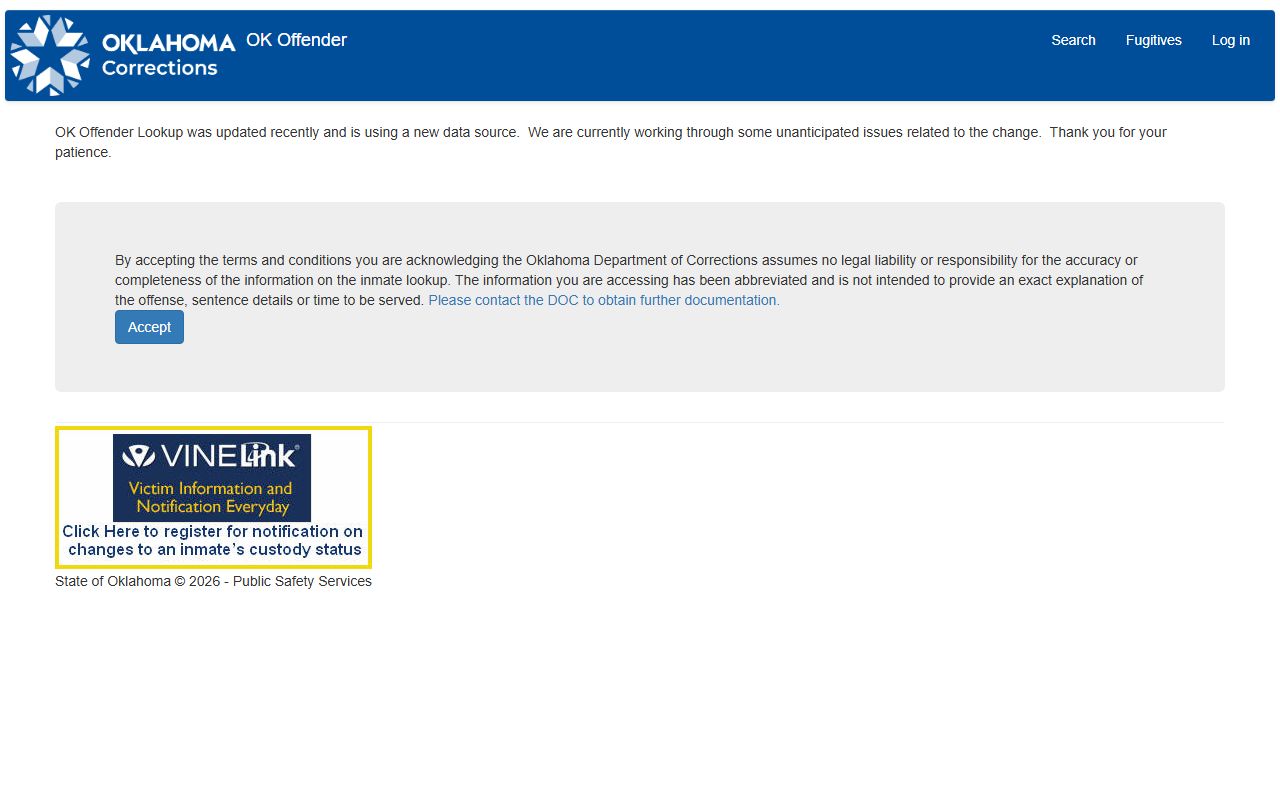
For active county cases, OSCN and ODCR still give the closest read on filed charges.
Note: The DOC system covers sentenced state offenders, so a person held only in the Custer County jail may not appear there at all.
Background Check Considerations
A charge lookup and a background check differ. A court search shows the charges in one case. A background check gathers records into a report and falls under federal law. Employers, landlords, and lenders who screen people must follow the Fair Credit Reporting Act. A casual OSCN or ODCR search does not meet that bar. For a hiring or housing decision, use a licensed consumer reporting agency.
Important: This is not an FCRA-regulated consumer reporting agency, and its records may not be used for credit, employment, tenant, or insurance screening.
Restricted Charge Records in Custer County
Not every charge stays in public view. Juvenile charges sit outside the ordinary public docket. Sealed and expunged charges drop out of search after a court order. Oklahoma allows eligible arrest and court records to be sealed under Title 22. Dismissed counts can be cleared from public access through that process.
Some details inside an open file are hidden as well. Social Security numbers, financial account numbers, and protected addresses are redacted. Charges tied to an ongoing investigation may be withheld for a time. To view a restricted charge record, a person usually must be a party, an attorney, or an agency, or hold a court order. The Custer County Court Clerk can explain what is open and how to request it.